


An interactive meeting stands or falls with one thing: everyone must be able to participate. That sounds simple, but in practice, part of the group disengages as soon as the screen is hard to see, the presenter turns their back to the audience, or the technology fails. Want to avoid that? It starts with the right environment. Read on and discover how to turn every meeting into a session where everyone is involved.
What makes a meeting interactive?
An interactive meeting is more than a presentation where participants occasionally ask a question. It’s about creating an environment where everyone actively thinks along, responds, and contributes. Several elements are essential.
The content must be clearly visible to everyone. A screen that is too low, too small, or difficult to read from certain angles immediately causes distraction. Technology should not be a barrier. The longer it takes to start a presentation, the more attention is lost. And the setup should encourage participation. A screen that can easily be rotated, raised, or moved helps keep the group engaged. In short: an interactive meeting requires a space that supports the process, not hinders it.
How does the right setup create an interactive meeting?
The positioning of your screen or touchscreen has more influence on interactive meeting formats than many people think. Is the screen too low? Half the room ends up looking through someone’s head. Too high? You lose the back rows. The right height is essential.
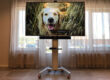
With a TV lift system from ErgoXS, you can adjust the screen to the desired height at the touch of a button. Whether you’re working in a boardroom with a large touchscreen or using an interactive whiteboard in a meeting room, the systems are designed for easy, intuitive use. The Safety Stop also ensures the system automatically stops if it encounters an obstacle during adjustment.
Cables and power strips can be neatly concealed within the frame, preventing distracting elements from hanging beneath the screen. A clean setup looks professional and keeps the focus on the content—where it belongs.
Which spaces benefit most from interactive meetings?
Active meeting formats are not limited to boardrooms. In classrooms, a well-positioned interactive whiteboard can make the difference between an engaged class and one that loses focus. In hospitals and banks, interactive meetings are increasingly supported by large touchscreens that allow everyone to follow and respond in real time.
Across all these environments, the need is the same: a screen in the right position, easy to use, and clearly visible for everyone. ErgoXS offers systems for wall, floor, and ceiling mounting, as well as mobile solutions for flexible spaces. There is always a solution that fits the room.
Tips for an interactive meeting that really works
Interactive meetings work better when you make a few practical choices in advance:
- Start with the end user. Who uses the space, how often, and for what purpose? A room with frequently changing users requires a system that is quick and intuitive to adjust.
- Choose a setup that fits the space. A mobile system works well in flexible environments, while wall mounting suits fixed meeting rooms.
- Ensure proper cable management. Loose cables are distracting and look unprofessional. Choose a system that neatly conceals cables and power strips.
- Consider the height. Always adjust the screen to the average viewing height of participants, not just what is convenient for the presenter.
Time for an interactive meeting
Investing in an interactive meeting is essentially investing in attention: attention to the content, the participants, and an environment that supports both. ErgoXS helps you achieve this with a wide range of lift systems that prepare your space for every interactive meeting.